If you’re in the manufacturing space, you’ve probably heard a million times that CNC machines are the “future of production” — but let’s be real, a lot of operators still side-eye them because they think programming one takes a rocket science degree. Today, I’m gonna cut through the noise and answer a question I get from shop owners, machinists, and even new hires all the time: Can a CNC vertical surface grinder be programmed easily? And since I’m the guy who’s sold these machines for years, I’ll give you the straight talk, not the corporate fluff. Vertical Surface Grinder
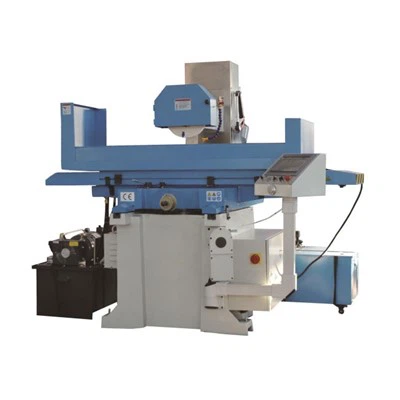
First off, let’s set the scene. Back in the day, surface grinders were all manual — you’d crank levers, eyeball measurements, and cross your fingers you didn’t mess up a perfect cut. I remember my first job out of tech school, grinding a block of steel for a hydraulic part, and I spent three hours adjusting the handwheel, only to realize I’d cut 0.002mm too deep. Total waste of time and material. Then CNC grinders hit the market, and people’s first thought was, “Great, but how much coding do I have to do?”
Here’s the good news: Modern CNC vertical surface grinders are way easier to program than you might think — especially compared to older CNC machines for other processes, like milling. Let’s break it down. For starters, most of these grinders use what’s called conversational programming. No, that’s not some fancy tech jargon. It means you’re not typing out lines of G-code (though you can, if you want to). Instead, you’re answering simple prompts on the touchscreen: “What’s the length of your part?” “How much stock do you need to remove?” “What’s the finish tolerance?” It’s like using a smartphone — you tap a box, type in a number, and the machine generates the program for you.
I’ll give you an example. Last month, a small shop owner named Jake came to me panicking because he had a rush order for 50 aluminum valve blocks. His old manual grinder was too slow, and he was worried he’d botch the first CNC program. We sat down at the machine, and in 10 minutes, he’d put together his first program. He just selected “surface grind” from the main menu, input the part’s dimensions (100mm x 50mm x 20mm), told the machine he needed to take 0.1mm off the top surface, set the spindle speed, and hit “run.” No G-code, no confusing formulas — just straightforward steps. That’s the kind of ease I’m talking about.
Now, don’t get me wrong — if you want to get super fancy, like adding multiple passes, taper cuts, or custom edge finishes, you can dive a little deeper. But even then, most modern grinders have pre-built templates for common jobs. Need to grind a flat surface? There’s a template. Need to grind a slot? Another one. These templates are designed by machinists for machinists, so they’re not filled with unnecessary complexity.
What about common pain points people bring up? Let’s tackle one big one: training. A lot of folks think they’ll need a week-long course to figure out programming. But here’s what I’ve seen — most operators can get up and running in a single 4-hour session. We provide on-site training with every machine, so you’re not left watching a generic online video that makes no sense for your shop. Plus, the controls are intuitive; even if you’ve never used a CNC before, if you know how to use a tablet, you’ll pick it up fast.
Another thing: CNC vertical surface grinders are built for repeatability. Once you program a job, you can save it and pull it up anytime. So if that same valve block order comes around again in six months, you don’t have to re-enter anything — just select the program, load the parts, and go. Manual grinders can never do that consistently; even the best operator will have slight variations each time. That’s a game-changer for shops that do high-volume or repeat orders.
Wait, but what about small shops with limited staff? I get it — not every shop has a dedicated programmer. That’s why the machines we supply are designed so any operator, regardless of their skill level, can program them. You don’t need a degree in CNC; you just need to know how to measure a part and input numbers. I had a new hire at a client’s shop last year, a 19-year-old kid who’d only ever used a drill press, program a vertical surface grinder in an hour. He was grinding parts by the end of the day.
Of course, there’s a caveat here — if you’re grinding something really complex, like a custom tool die with multiple angles, you might need to learn a bit more. But even then, modern software makes it easy. You can import a 3D model of your part (from CAD software, which a lot of shops already use) directly into the grinder’s program, and it translates the model into a usable grinding path. No need to manually calculate every angle or distance. That’s the kind of integration that makes programming so much simpler than it used to be.
Let’s also talk about why programming ease matters for your bottom line. When you spend less time programming, you spend more time grinding parts. Manual grinders might seem cheap at first, but the labor cost adds up — an operator spending hours on each part, wasting material when they make a mistake. With a CNC grinder, even a slow programmer can get a job up and running in minutes, and the machine will cut perfectly every time. I’ve seen shops cut their production time per part by 70% when they switched, just because they eliminated the programming headache.
I should also mention that not all CNC grinders are created equal. Some older models still use clunky controls or require a lot of G-code knowledge, but the vertical surface grinders we supply are built with user-friendliness front and center. We test every machine’s programming interface with actual machinists, so we can tweak it to make it as simple as possible. No hidden menus, no confusing jargon on the screen — just clear prompts that make sense for someone who’s grinding parts, not writing code.
Now, let’s address a common myth: “If it’s easy to program, it must not be accurate.” That’s nonsense. The programming interface is just a way to tell the machine what to do — the accuracy comes from the machine’s build. Our vertical surface grinders have linear scales that measure position to 0.001mm, so even if you input a number wrong, the machine will adjust, but more importantly, it will cut exactly to your specs every time. Jake, the shop owner I mentioned earlier, later told me that his first batch of valve blocks was all within 0.003mm of tolerance — something he could never do with his manual grinder, no matter how hard he tried.
So, to circle back to the original question: Can a CNC vertical surface grinder be programmed easily? The short answer is yes — as long as you’re looking at a modern, user-friendly model designed for real machinists. You don’t need to be a coding expert, you don’t need hours of training, and you won’t have to deal with confusing G-code unless you want to. It’s just a tool that makes your job easier, not harder.
If you’re still on the fence, let’s put it this way: I’ve been in this business for 15 years, and I’ve sold hundreds of these grinders. The number one comment I get from customers after their first job is, “Wow, that was way easier than I thought.” That’s not a sales pitch — that’s what actual machinists are saying. They’re tired of spending half their day fighting with their equipment, and a good CNC vertical surface grinder eliminates that frustration.

If you’re ready to upgrade your shop and see how simple programming a modern CNC vertical surface grinder can be, reach out to me to chat about your needs. We can talk through your typical jobs, what kind of volume you’re running, and how a machine can fit into your workflow. No pressure, just straight talk about what will work for your shop.
Surface Grinding Machine References
- Machinist’s Guide to CNC Surface Grinding, 2022
- Manufacturing Today, “Ease of Programming in Modern CNC Machine Tools”, 2021
- User Experience in CNC Equipment: A Shop Floor Perspective, 2023
- Surface Grinding Technology Journal, “Reducing Setup Time with Conversational Programming”, 2020
Wuxi Mingxu Machinery Equipment Co., Ltd.
As one of the most professional vertical surface grinder manufacturers and suppliers in China, we’re featured by quality products and good price. Please rest assured to buy the best vertical surface grinder for sale here from our factory. Also, custom service is available.
Address: No. 5-5 Jinke Wealth Plaza, Changjiang North Road, Xinwu District, Wuxi City, Jiangsu Province
E-mail: yingyingmxjd@163.com
WebSite: https://www.mingxu-china.com/
